Are You Suddenly Paying More for Your Medications?
Your Copay Assistance May No Longer Count Towards Your Deductible or Maximum Out-of-Pocket limit
What is a copay accumulator adjustment policy?
Are you suddenly paying more for your medications?
If you are among the millions of patients who rely on copay coupons or assistance from a drug company to afford your medications, you may have been suddenly asked to pay more for your drugs when you order them or pick them up at the pharmacy. If that has happened to you, it may be due to new insurance company policies that don’t count your coupon or other financial assistance toward your annual deductible or out-of-pocket maximum.
Why are you facing new, steep out-of-pocket costs?
You may be experiencing what is sometimes called “copay accumulators” or CAAPs that are affecting patients across the country. Confusing language has been slipped in the fine print of health insurance plans that leaves patients on the hook for potentially thousands of dollars in increased and unexpected out of pocket costs.
The Good News
The good news is that some states have adopted laws that prohibit insurance companies and PBMs from using copay accumulators altogether and ensure that your copay assistance counts toward your annual deductible and out-of-pocket maximum. And many more states are looking to do the same in 2020.
Click here to find out if your state has adopted one of these laws.
The Bad News
The US Department of Health & Human Services has squashed a victory for patients when they revoked their initial instruction to insurance companies and PBMs stating that they could only use copay accumulators in limited circumstances:
- There is no generic available for your brand name drug
- You gained access to the brand name drug using the insurer’s appeals or exceptions process
Now in the proposed 2021 Notice of Benefit and Payment Parameters, HHS says insurers have the flexibility to determine whether to include or exclude coupon amounts from the annual limitation on cost sharing, regardless of whether your drug has generic available.

How Does It Work?
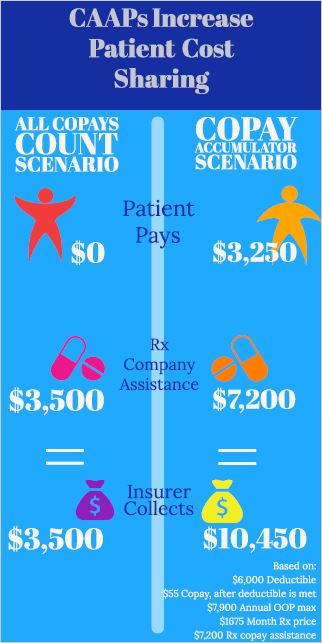
Increased Costs:
For months, you will use their copay assistance to pay for their prescriptions without issue. At some point, the assistance runs out. You then learn that the insurance company has not been counting the copay assistance towards your deductible or cost-sharing limits, forcing you to pay the full cost for your drugs.
Some patients may abandon their medication because they can’t afford it. A recent study concluded that more than 70 percent of patients who were faced with paying more than $250 for their prescription did not pick them up.
Misleading, Hidden Language:
When you shop for and choose an insurance plan, the issuer must provide detailed information up front about all the policies and costs related to the plan. Sometimes, insurance companies use complicated and confusing language to describe copay accumulator policies, which can be buried in the fine print of insurance policy documents. Unless you are looking for it, and know where to find it, you might miss it!
Follow the links below to see examples of the plan language.
See the Impact on Patients See Insurance Plan ExamplesShare Your Story
Do you use copay assistance and have questions about the increased cost of your prescriptions at the pharmacy counter? Do you think your health plan may have a “copay accumulator” policy? Help us fight these policies by sharing your story. Please tell us what happened when you tried to pick up your medication and learned that your copay assistance wasn’t counting toward your deductible or cost-sharing limit. Were you able to get your medication? How did this policy affect you?
The following is a private portal where you can securely share your experience and contact information.
All submissions are confidential.
What's Your Story?

What You Can Do
Patients can ask their insurers or employers if copay accumulators are a part of their health plan.
Tips to find out if you have a copay accumulator:
- Call your insurance plan.
- Tell the consumer representative you use copay assistance to pay for your prescription.
- Ask the representative if the amount covered by the copay assistance will count toward your deductible and out-of-pocket maximum.
Patients should also contact their state insurance commissioners and state and federal legislators to demand they prohibit these policies for vulnerable patients who need access to life-saving medications. With the onset of the COVID-19 pandemic, it’s more important than ever that patients have the coverage that they need. That’s why we support H.R. 7647, a bipartisan bill in the House of Representatives that would postpone the implementation of copay accumulators until after the end of the COVID-19 pandemic. During this global crisis especially, no one should have to worry about losing their copay assistance.
Visit our new patient portal to tell us your experience and learn more about how to fight back against these programs.
Take ActionAbout Us
The All Copays Count Coalition is comprised of groups serving the interests of beneficiaries with chronic and serious health conditions that rely on copay assistance in various forms to make medically necessary drug treatments affordable. The coalition acts as a clearinghouse of information about the harmful effects of health plan policies, known as “copay accumulators,” on access to prescription drugs for people with chronic and serious health conditions.
Members of the coalition are united in their belief that copay accumulators impede access to care, and they support measures to assure that copay assistance counts toward health plan enrollees’ annual deductible and/or maximum out-of-pocket amounts. Patient groups are encouraged to sign up for an email list serve to share information and resources, facilitate the collection of verifiable patient stories from individuals harmed by copay accumulators, and to promote awareness and potential resolution through the media, advocacy and potential litigation opportunities.
Potential public policy solutions are considered through deliberations of the steering committee, a state regulatory group, and through other subcommittees. To preserve the group’s credibility as a voice for people with chronic and serious health conditions, groups and individuals with a financial interest in copay accumulator programs are discouraged from active participation in coalition activities.
Funding was received to support the initial development of this website. However, the ACCC Steering Committee maintains the website with total independence and has ultimate authority over website design, development, content, and policy positions. ACCC does not endorse any medical product, treatment protocol, medical service or industry interests.